In a nutshell
A species is the basic unit of classification, and the rule for it is simple: two organisms are the same species if they can breed to produce fertile offspring.
This subtopic is about how we tell species apart (courtship behaviour), and how biologists sort all species into a single hierarchy of groups (taxonomy) that reflects how closely related they are.
Assumed knowledge: How genetic diversity can arise, Genetic diversity and adaptation.
Core content
What is a species?
Two organisms belong to the same species if they are able to produce fertile offspring.
The word that carries the mark is fertile. Members of different species may occasionally mate, but their offspring (if any) are infertile, so they cannot be the same species.
- A horse and a donkey can mate and produce a mule, but a mule is infertile, so horse and donkey are different species.
- "Viable offspring" or "offspring" on its own is not enough: the offspring must be fertile.
A species is also a group of organisms with similar features and the same number of chromosomes, but the fertile-offspring test is the one AQA rewards, so lead with it.
A quick sense-check: if you can only remember one thing about a species, remember "produces fertile offspring". Dropping "fertile" is the single most common way students lose this mark.
Courtship behaviour
Courtship behaviour is a set of species-specific behaviours carried out before mating. It is a necessary precursor to successful mating: without the correct courtship, mating does not proceed.
Courtship is genetically determined and specific to each species, so it acts as a signal that only members of the same species recognise and respond to. This is its role in species recognition.
What courtship achieves (each of these can be a separate marking point):
- Recognises members of the same species, so mating happens only within the species. This avoids wasting gametes and energy on a mating that could not produce fertile offspring.
- Attracts and recognises a mate of the opposite sex.
- Indicates sexual maturity, fertility and readiness to mate, so both partners are able to reproduce.
- Stimulates mating and synchronises it, so that the release of gametes is timed together.
- Forms a pair bond, which in some species helps the parents raise the offspring.
Examples: a male peacock displays its tail feathers, male fireflies use species-specific flashing patterns, and many frogs use species-specific calls. In each case only the correct species produces and responds to the signal.
Still don't get it? · why courtship is species-specific
Think of courtship as a password. Each species has its own password, built into its genes: a particular dance, call, flash pattern or scent. A female only "unlocks" and mates if she receives the exact password her species uses.
Now think about why that matters. Mating with the wrong species is a waste: any offspring would be infertile (or there would be no offspring at all), so the gametes, time and energy are thrown away. A password that only your own species can give stops that from happening before mating even starts.
Exam version: courtship behaviour is species-specific, so it allows species recognition. It lets an organism recognise a mate of the same species and the opposite sex, indicate sexual maturity, synchronise mating and the release of gametes, and form a pair bond. Because it acts as a necessary precursor to mating, it prevents members of different species from breeding.
Classification and taxonomy
Classification is the arrangement of organisms into groups. Each group is called a taxon (plural taxa), and taxonomy is the study of this classification.
A phylogenetic classification system arranges species into groups based on their evolutionary origins and relationships, so that organisms in the same group share a common ancestor.
It is a hierarchy: smaller groups are placed within larger groups, with no overlap between groups. An organism belongs to exactly one group at each level, and that group sits entirely inside the group above it.
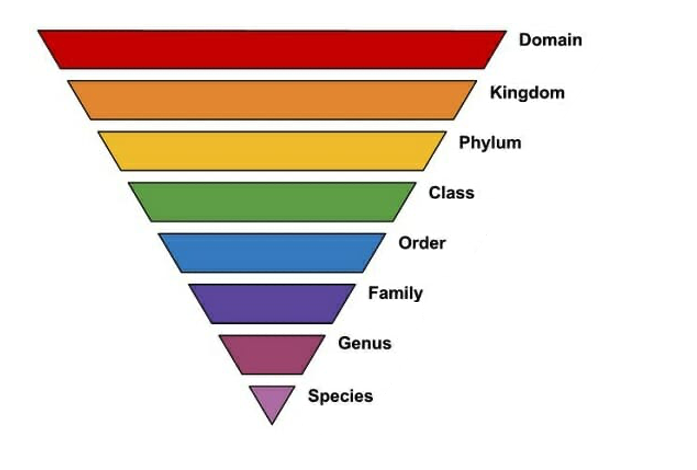
The single hierarchy you must know, from the largest group to the smallest:
Domain, Kingdom, Phylum, Class, Order, Family, Genus, Species.
A mnemonic helps you recall the order: Dear King Philip Came Over For Good Soup (Domain, Kingdom, Phylum, Class, Order, Family, Genus, Species).
Worked down the ranks for one species, humans:
| Taxon | Human |
|---|---|
| Domain | Eukarya |
| Kingdom | Animalia |
| Phylum | Chordata |
| Class | Mammalia |
| Order | Primates |
| Family | Hominidae |
| Genus | Homo |
| Species | sapiens |
You do not need to recall alternative systems such as the three-domain or five-kingdom systems, only this single hierarchy.
Still don't get it? · "groups within groups, with no overlap"
Picture a set of Russian dolls, but where a bigger doll can hold several smaller dolls at once. The whole animal kingdom is the biggest doll. Inside it sit several phyla; inside one phylum sit several classes; and so on down to genus and species.
The key rule is that a smaller doll is always completely inside one bigger doll. A genus sits inside exactly one family. It never straddles two families, and two genera in the same family sit side by side without any overlap. So when you draw a hierarchy as circles, each smaller circle is drawn fully inside a larger one, and circles at the same level never intersect.
Exam version: a hierarchy places smaller groups within larger groups, with no overlap between groups. Missing the phrase "no overlap" is the most common way to lose this mark, so write it every time.
Naming a species: the binomial system
Every species is universally identified by a binomial: a two-part name made of its genus and species, for example Homo sapiens.
The conventions matter:
- The genus name comes first and starts with a capital letter (Homo).
- The species name comes second and is written in lower case (sapiens).
- The whole name is written in italics (or underlined when handwritten).
Because the name is universal, it avoids the confusion of common names, which differ between languages and regions. It also shows relationship: two organisms that share the same genus are closely related.
Evolutionary relationships and common ancestors
Because a phylogenetic system reflects evolution, the diagrams biologists draw (phylogenetic trees) show common ancestors and points where groups diverged.
The rule for reading them: organisms that share a more recent common ancestor are more closely related.
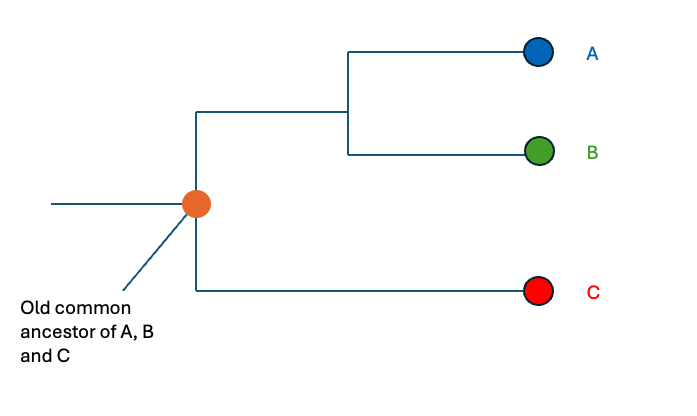
- Any statement about relatedness must be comparative: for example, "A and B share a more recent common ancestor with each other than with C", not just "A and B are related".
- On a tree, "common ancestor" means a shared ancestral species at a branch point. It is not a family tree of parents and grandparents.
Immunology and genome sequencing as evidence
Modern evidence lets us clarify evolutionary relationships far more precisely than appearance alone. You should appreciate that advances in genome sequencing and immunology help clarify how closely species are related.
- Genome sequencing compares the base sequence of DNA between species. The more similar the base sequences, the more closely related the species and the more recent their common ancestor.
- Immunology compares proteins between species (for example by how similarly their proteins react with the same antibodies). More similar proteins indicate more closely related species.
The logic is the same in both cases: closely related species diverged more recently, so they have had less time to accumulate differences, and their DNA and proteins are more alike.
Worked examples
Model 4-mark answer: "Explain how courtship behaviour helps a female bird mate successfully."
A strong answer makes four separate, linked points, not one point repeated:
- Courtship allows her to recognise a member of her own species (species recognition).
- It allows her to recognise a mate of the opposite sex.
- It indicates that the male is sexually mature and able to reproduce (or synchronises mating so gametes are released together).
- It forms a pair bond (or acts as a necessary precursor that stimulates mating).
The lesson: a 4-mark "explain" needs four distinct courtship roles, each worth one mark. Listing "attracts a mate" three different ways scores once.
Model 2-mark answer: "Use the phylogenetic tree to compare how closely species A, B and C are related."
- A and B share a more recent common ancestor with each other than either does with C.
- Therefore A and B are more closely related (than either is to C).
The lesson: the marks are for a comparative statement using "more recent common ancestor" (or "more closely related"). A non-comparative statement such as "they are related" scores nothing.
Common exam mistakes
- Defining a species as producing "viable offspring" or just "offspring". The mark requires fertile offspring; "viable" is rejected.
- Treating "mating" as the same as "reproduction" in the species definition. AQA credits the ability to reproduce (breed) to produce fertile offspring, so "can mate" is not enough.
- Calling members of a species "genetically identical". They are not (there is variation within a species); this phrasing is rejected.
- Defining a hierarchy as "groups within groups" but forgetting "no overlap". Both ideas are needed; the missing "no overlap" is the most common lost mark here.
- Defining a phylogenetic group by the wrong half of the word, for example "a group within a hierarchy" or "organisms with similar genes", instead of a group based on evolutionary origins and relationships / common ancestry.
- Drawing the nested hierarchy wrong: placing same-level groups (for example two genera) in separate circles instead of nesting each smaller group inside the larger group with no overlap.
- Getting the binomial the wrong way round or wrong case: the genus is first with a capital letter, the species is second and lower case (writing "sapiens Homo" or "homo Sapiens" loses the mark).
- Reading a phylogenetic tree as a family tree of parents and grandparents, or reading "common ancestor" as "an ancestor found in large numbers".
- Making a relatedness claim that is not comparative, or saying sequences are merely "similar" when the mark needs "identical / the same" or an explicit "more closely related / more recent common ancestor".
- Confusing the DNA base sequence with the amino acid sequence when describing molecular evidence, or writing "DNA is made of amino acids".
Key definitions
- Species: a group of similar organisms that are able to reproduce to produce fertile offspring.
- Courtship behaviour: species-specific behaviour that acts as a necessary precursor to mating, allowing species recognition and successful reproduction.
- Species recognition: the identification of, and response to, a mate of the same species (and opposite sex) before mating.
- Taxon (plural taxa): a group into which organisms are classified.
- Taxonomy: the study of the classification of organisms into groups.
- Phylogenetic classification: a system that arranges species into groups based on their evolutionary origins and relationships.
- Hierarchy: an arrangement in which smaller groups are placed within larger groups, with no overlap between groups.
- Binomial: the universal two-part naming system in which a species is identified by its genus (capital, first) and species (lower case, second), e.g. Homo sapiens.
Specification
- I can state that two organisms belong to the same species if they are able to produce fertile offspring.
- I can explain how courtship behaviour is a necessary precursor to successful mating and describe its role in species recognition.
- I can describe a phylogenetic classification system as arranging species into groups based on their evolutionary origins and relationships.
- I can explain that a hierarchy places smaller groups within larger groups with no overlap, and that each group is a taxon (plural taxa).
- I can name, in order from largest to smallest, the taxa: domain, kingdom, phylum, class, order, family, genus and species.
- I can state that each species is universally identified by a binomial consisting of the name of its genus and species (e.g. Homo sapiens).
- I can appreciate that advances in immunology and genome sequencing help to clarify evolutionary relationships between organisms.
Related notes
Ready to test yourself?
Put Species and taxonomy into practice with exam-style questions and full mark schemes.
Practise Species and taxonomy