In a nutshell
Nucleic acids are the information-carrying molecules of life. There are two: DNA, which holds the genetic information in a cell, and RNA, which transfers genetic information from DNA to the ribosomes.
This subtopic is about how DNA and RNA are built from nucleotides, how the two strands of DNA are held together, and how DNA copies itself exactly by semi-conservative replication.
Assumed knowledge: Monomers and polymers.
Core content
Nucleotides: the monomers of nucleic acids
Both DNA and RNA are polymers of nucleotides (they are polynucleotides).
A nucleotide is made of three parts joined together:
- a pentose (a five-carbon sugar),
- a nitrogen-containing organic base,
- a phosphate group.
The nitrogen atom sits in the base, not in the sugar or the phosphate.
DNA and RNA nucleotides differ
The two nucleic acids use slightly different nucleotides:
| Component | DNA nucleotide | RNA nucleotide |
|---|---|---|
| Pentose sugar | deoxyribose | ribose |
| Phosphate group | one phosphate | one phosphate |
| Organic bases | adenine, cytosine, guanine, thymine | adenine, cytosine, guanine, uracil |
The single most important swaps to memorise: DNA has deoxyribose and the base thymine; RNA has ribose and, in place of thymine, the base uracil.
Joining nucleotides: the phosphodiester bond
Nucleotides join in a condensation reaction (a bond forms and a molecule of water is released).
The bond forms between the phosphate group of one nucleotide and the sugar of the next, and is called a phosphodiester bond.
Many nucleotides joined this way make a polynucleotide: a sugar-phosphate backbone with the bases pointing off it. Hydrolysis (adding water) reverses the process and breaks the phosphodiester bonds.
The structure of DNA: a double helix
A DNA molecule is a double helix: two polynucleotide strands coiled around each other.
The two strands are held together by hydrogen bonds between specific complementary base pairs:
- adenine pairs with thymine (A with T),
- cytosine pairs with guanine (C with G).
Each A-T pair is held by two hydrogen bonds and each C-G pair by three. A single hydrogen bond is weak, but there are so many along the molecule that together they hold the two strands firmly, while still being easy to separate for replication.
Watch the vocabulary, because examiners penalise loose use of it:
- a polynucleotide (or strand) is one chain of nucleotides,
- the double helix is the whole molecule, made of two polynucleotide strands.
The structure of RNA
An RNA molecule is a relatively short polynucleotide chain (a single strand, not a double helix).
RNA's job in this topic is simple to state: RNA transfers genetic information from DNA to the ribosomes, where proteins are made.
Ribosomes themselves are made from RNA and proteins. (In an exam, "RNA and protein" is the credited answer; "DNA" is rejected.)
DNA compared with RNA
| Feature | DNA | RNA |
|---|---|---|
| Sugar | deoxyribose | ribose |
| Bases | A, C, G, T (thymine) | A, C, G, U (uracil) |
| Number of strands | two (double helix) | one (single, relatively short) |
| Role | holds genetic information | transfers genetic information to ribosomes |
Why scientists doubted DNA carried the genetic code
DNA is built from only four different bases, which made it look too simple to store the instructions for the thousands of different proteins an organism needs.
Because of this relative simplicity, many scientists at first doubted that DNA was the molecule that carried the genetic code, and thought the more varied proteins were a likelier candidate. Later evidence showed the code lies in the sequence of bases along the DNA.
Complementary base pairing lets you work out base proportions
Because A always pairs with T, and C always pairs with G, in a double-stranded DNA molecule:
- the amount of adenine equals the amount of thymine (A = T),
- the amount of cytosine equals the amount of guanine (C = G).
So if you are told the percentage of one base, you can work out the others (see Worked examples).
This is also a clue about structure. If a sample's bases do not follow these rules (for example A does not equal T), the bases cannot all be paired, so the molecule is not double-stranded. It must be single-stranded (for example RNA, or a single-stranded virus genome).
Semi-conservative replication of DNA
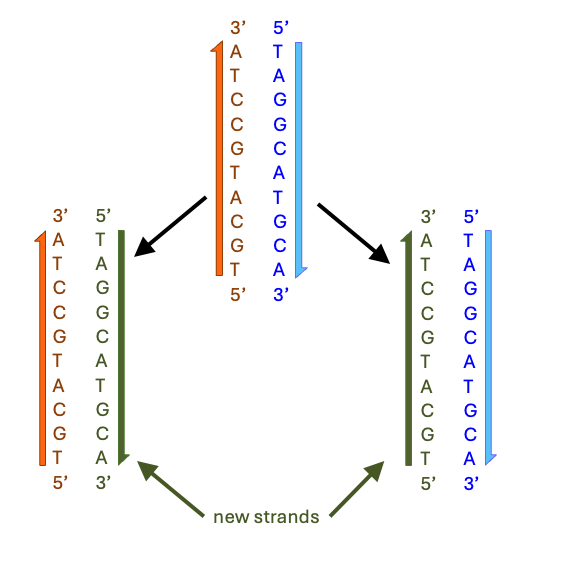
Before a cell divides it must copy its DNA exactly, so that both new cells get a full set of genetic information. DNA copies itself by semi-conservative replication, which ensures genetic continuity between generations of cells.
"Semi-conservative" means each new DNA molecule keeps one original (template) strand and gains one newly made strand.
The steps AQA credits, in order:
- DNA helicase breaks the hydrogen bonds between the complementary bases, unwinding the double helix and separating the two strands.
- Both separated strands act as templates.
- Free DNA nucleotides are attracted to the exposed bases on each template strand and line up by complementary base pairing (A with T, C with G).
- DNA polymerase catalyses the condensation reaction that joins the adjacent nucleotides, forming phosphodiester bonds along each new strand.
- The hydrogen bonds reform between the base pairs.
- Each new DNA molecule is made of one original strand and one new strand, so replication is semi-conservative.
Still don't get it? · what "semi-conservative" actually means
Imagine you have a treasured recipe written on a folded card, with the left half and the right half saying exactly matching things (that is the point of complementary strands: each half already tells you what the other half must say). To make two copies, you unfold the card into its two separate halves. Then, against each half, you write a fresh matching half. You end up with two full cards, and crucially, each finished card is one old half plus one brand-new half.
Now the biology. The two DNA strands are complementary, so each one carries all the information needed to rebuild its partner. Helicase "unfolds" the molecule by breaking the hydrogen bonds. Each old strand is a template, and free nucleotides pair up against it, so a new partner strand is built. Every daughter molecule therefore contains one conserved (old) strand and one new strand.
In the exam, the mark-scheme phrase is that each new DNA molecule contains "one original strand and one new strand". Do NOT write that each new molecule "contains half of the original strand": half a strand is wrong and loses the mark. It is a whole old strand plus a whole new strand.
Validating the model: the Meselson and Stahl experiment
When Watson and Crick proposed the DNA model, it was not obvious that replication was semi-conservative. It could in principle have been conservative (the whole original molecule stays intact and an entirely new molecule is made). Scientists tested the two ideas.
The bases in nucleotides contain nitrogen, so DNA can be "weighed" by growing organisms in different nitrogen isotopes:
- DNA grown in heavy nitrogen (15N) is denser than DNA grown in light nitrogen (14N).
- Cells grown for many generations in 15N were switched to 14N, and their DNA density was checked after each round of replication.
The result: after one round of replication in 14N, all the DNA was of intermediate density, a single band between the heavy and light positions. This is exactly what semi-conservative replication predicts (every molecule = one old 15N strand + one new 14N strand). Conservative replication would have given two separate bands (one all-heavy, one all-light), which was not seen. The evidence therefore supported the Watson-Crick model.
Still don't get it? · how the experiment tells the two models apart
Picture sorting coins by weight down a slope: heavy coins settle low, light coins settle high, and a coin that is half-heavy-half-light settles exactly in the middle. That middle band is the whole trick.
Start with DNA where both strands are "heavy" (15N). Replicate once in a "light" (14N) supply. Semi-conservative says every new molecule keeps one heavy strand and builds one light strand, so every molecule is half-and-half and sits as one middle band. Conservative says the original heavy molecule stays whole and a brand-new all-light molecule is made alongside it, which would give two bands, one low and one high, and no middle band.
The experiment found only a single middle band after the first generation. So the middle band is the fingerprint of semi-conservative replication, and the absence of a two-band result rules conservative replication out. In an exam, the creditworthy point is that an intermediate-density band is what semi-conservative replication predicts, and that this is evidence that validates the model.
Worked examples
Model answer 1: base-proportion calculation (using complementary base pairing).
In a sample of double-stranded DNA, 20% of the bases are adenine. Calculate the percentage of each of the other three bases.
Adenine pairs with thymine, so the two are present in equal amounts:
Together A and T make up 40% of the bases, so cytosine and guanine make up the rest:
Cytosine pairs with guanine, so they too are equal, and each is half of 60%:
Answer: thymine 20%, cytosine 30%, guanine 30% (check: 20 + 20 + 30 + 30 = 100%).
The whole method rests on A = T and C = G, so state which base pairs with which as your working; that is where the reasoning mark sits.
Model answer 2: describing semi-conservative replication. (5 marks)
Describe how a molecule of DNA is copied by semi-conservative replication.
A 5-mark "describe" needs five distinct, linked points in the right order:
- DNA helicase breaks the hydrogen bonds between the bases, so the double helix unwinds and the two strands separate.
- Both strands act as templates.
- Free DNA nucleotides pair with the exposed bases by complementary base pairing (A with T, C with G).
- DNA polymerase joins adjacent nucleotides together, forming phosphodiester bonds on each new strand.
- Each new DNA molecule contains one original strand and one new strand.
Notice what earns marks: naming the enzymes and giving each its correct job, and saying both strands are templates. Vague verbs like "the DNA unzips" are not enough on their own.
Common exam mistakes
- Spelling thymine wrongly. It is thymine, not "thiamine" (thiamine is vitamin B1); examiners reject misspellings of this base and only credit the correct name.
- Naming the DNA sugar only as "pentose" or "sugar", or writing "ribose" for DNA. The mark needs deoxyribose; "pentose" alone is not specific enough.
- Writing "phosphorus" or just "P" for the phosphate group. The creditworthy word is phosphate.
- Putting uracil in DNA or thymine in RNA. DNA uses thymine; RNA replaces it with uracil.
- Saying DNA helicase "unwinds" or "unzips" the DNA and stopping there. At A-level you must say it breaks the hydrogen bonds between the bases.
- Giving DNA polymerase the wrong job: saying it "forms the hydrogen bonds" or "makes the bases pair up". DNA polymerase joins adjacent nucleotides by forming phosphodiester bonds; it does not cause base pairing.
- Saying that "free bases attach" to the template. It is free nucleotides that attach, not bare bases.
- Saying only one strand acts as a template. Both strands act as templates.
- Describing semi-conservative replication as each new molecule containing "half of the original strand". It is one whole original strand and one whole new strand.
- Confusing DNA replication with protein synthesis / transcription (for example writing that DNA polymerase makes mRNA). Replication copies DNA; it does not make RNA.
- Using "strand", "polynucleotide" and "molecule" loosely. A strand is one polynucleotide; the double helix is the molecule made of two strands.
- For a base-frequency question, forgetting A = T and C = G, or, when the bases are unequal, not realising this means the nucleic acid is single-stranded.
- Saying the nitrogen in a nucleotide is in the sugar or the phosphate. It is in the organic base.
Key definitions
- Nucleotide: the monomer of a nucleic acid, made of a pentose sugar, a nitrogen-containing organic base and a phosphate group.
- Polynucleotide: a polymer made of many nucleotides joined by phosphodiester bonds.
- Condensation reaction: a reaction that joins two molecules together with the formation of a chemical bond and the elimination of a molecule of water.
- Phosphodiester bond: the bond formed in a condensation reaction between the phosphate group of one nucleotide and the sugar of the next.
- Hydrolysis: the breaking of a chemical bond between two molecules involving the use of a water molecule.
- Complementary base pairing: adenine pairs with thymine (A-T) and cytosine pairs with guanine (C-G), the pairs held together by hydrogen bonds.
- Double helix: two polynucleotide strands coiled around each other, held together by hydrogen bonds between complementary base pairs.
- Semi-conservative replication: replication in which each new DNA molecule is made of one original (template) strand and one newly synthesised strand.
- DNA helicase: the enzyme that breaks the hydrogen bonds between the two strands of DNA, unwinding the double helix.
- DNA polymerase: the enzyme that catalyses the condensation reactions joining adjacent nucleotides (forming phosphodiester bonds) on the new strand.
Specification
- I can state that DNA holds genetic information and that RNA transfers genetic information from DNA to the ribosomes.
- I can state that ribosomes are made from RNA and proteins.
- I can state that both DNA and RNA are polymers of nucleotides, and name the three parts of a nucleotide (pentose, nitrogen-containing organic base, phosphate group).
- I can give the components of a DNA nucleotide (deoxyribose; a phosphate group; adenine, cytosine, guanine or thymine) and of an RNA nucleotide (ribose; a phosphate group; adenine, cytosine, guanine or uracil).
- I can describe how a condensation reaction between two nucleotides forms a phosphodiester bond.
- I can describe DNA as a double helix of two polynucleotide strands held together by hydrogen bonds between specific complementary base pairs (A-T, C-G).
- I can state that an RNA molecule is a relatively short polynucleotide chain.
- I can appreciate that the relative simplicity of DNA led many scientists to doubt that it carried the genetic code.
- I can use given base frequencies to work out the frequencies of the other bases.
- I can explain semi-conservative replication in terms of: unwinding of the double helix; breakage of hydrogen bonds; the role of DNA helicase; attraction of new nucleotides and base pairing on template strands; the role of DNA polymerase in the condensation reaction that joins adjacent nucleotides.
- I can evaluate how the work of scientists (the Meselson and Stahl experiment) validated the Watson-Crick model of DNA replication.
Related notes
Ready to test yourself?
Put Nucleic acids are important information-carrying molecules into practice with exam-style questions and full mark schemes.
Practise Nucleic acids are important information-carrying molecules