In a nutshell
Carbohydrates are the cell's main quick-release energy source, and in plants its structural scaffolding.
This subtopic is about how single sugars (monosaccharides) join by condensation into disaccharides and polysaccharides, and why the tiny difference between α-glucose and β-glucose decides whether a polymer stores energy or builds structure. It also covers the biochemical tests that identify sugars and starch.
Assumed knowledge: Monomers and polymers.
Core content
Monosaccharides: the monomers
Monosaccharides are the monomers from which larger carbohydrates are made.
The common ones you must know are glucose, galactose and fructose, all with the formula C6H12O6 (they are isomers of one another).
Glucose is the central molecule: it is the sugar respired for energy, and the building block of all three polysaccharides in this topic.
The two isomers of glucose
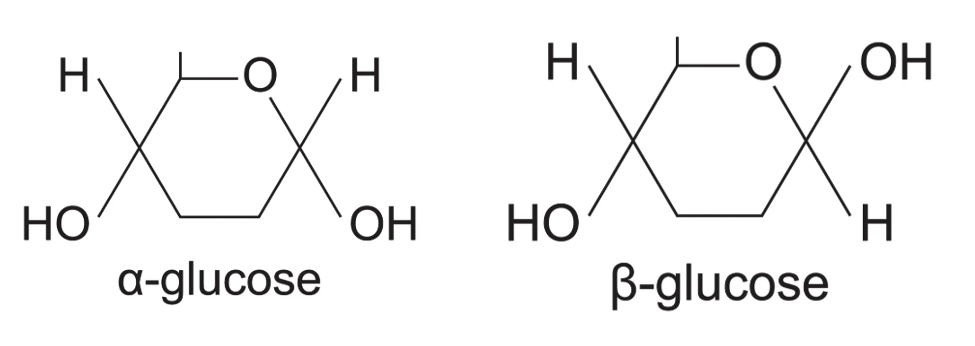
Glucose itself comes in two forms, α-glucose and β-glucose. They have the same atoms but differ in the position of the hydroxyl (OH) group on carbon 1:
- In α-glucose, the OH on carbon 1 points below the ring.
- In β-glucose, the OH on carbon 1 points above the ring.
That single flip is why starch and glycogen (both α) store energy while cellulose (β) is structural, so it earns marks throughout the topic.
Still don't get it? · why the alpha/beta flip changes everything
Imagine building a long chain from press-studs, where every stud sits on the bottom face of its block. Snap them together the same way up and the chain gently curls round on itself into a coil.
Now imagine the stud is on the top face instead. To make these blocks reach each other you have to flip every second block upside down. A chain of alternately flipped blocks does not curl: it lies dead straight and flat, and you can lay many straight chains side by side and tie them together.
That is exactly α versus β glucose. All-α chains (starch, glycogen) coil up compactly, which is perfect for cramming energy into a small space. β chains, with alternate molecules inverted, run straight and pack together, which is perfect for building strong fibres. In the exam, do not just say "glucose": name the isomer, α or β (written in full, not "a-glucose"), because the isomer is the mark.
The glycosidic bond, condensation and hydrolysis
Two monosaccharides join by a condensation reaction: a bond forms and a molecule of water is released.
The bond between the two sugars is a glycosidic bond. Because the OH groups involved are on carbon 1 of one sugar and carbon 4 of the next, this is a 1,4-glycosidic bond.
Splitting the bond again needs the reverse reaction, hydrolysis: a water molecule is added to break the glycosidic bond.
Disaccharides
A disaccharide forms by the condensation of two monosaccharides. You must know all three and their exact building blocks:
| Disaccharide | Made by condensation of | Where you meet it |
|---|---|---|
| Maltose | glucose + glucose | starch digestion, germinating seeds |
| Sucrose | glucose + fructose | transported sugar in plants, table sugar |
| Lactose | glucose + galactose | sugar in milk |
Polysaccharides
Polysaccharides are formed by the condensation of many glucose units. Starch and glycogen are condensed from α-glucose; cellulose is condensed from β-glucose. The whole point of this section is to link each structure to its function.
Starch (energy store in plants). Starch is a mixture of two polymers of α-glucose:
- Amylose: an unbranched chain with only 1,4-glycosidic bonds. The chain coils into a helix, which makes it compact.
- Amylopectin: a branched chain with 1,4- and 1,6-glycosidic bonds. The side branches give many free ends.
Starch is a good energy store because:
- it is insoluble, so it does not affect the water potential of the cell and does not draw water in by osmosis;
- it is compact (the coiled helix packs a lot of glucose into a small space);
- it is a large molecule, so it cannot diffuse out of the cell.
The branching in amylopectin means more ends for enzymes to act on, so glucose can be released quickly for respiration.
Glycogen (energy store in animals). Glycogen is a polysaccharide of α-glucose with 1,4- and 1,6-glycosidic bonds, and it is more highly branched than starch. It is stored in liver and muscle cells.
Like starch, it is insoluble (no osmotic effect) and large (cannot leave the cell). Its extra branching gives even more free ends for rapid hydrolysis to glucose.
This suits animals, which have a higher metabolic rate than plants and need to mobilise glucose fast.
Cellulose (structural in plants). Cellulose is a polymer of β-glucose joined by 1,4-glycosidic bonds, with alternate glucose molecules inverted (flipped over). This gives long, straight, unbranched chains.
Many of these parallel chains are held together by hydrogen bonds between the chains, bundling them into microfibrils (and microfibrils into macrofibrils).
The many hydrogen bonds give cellulose great tensile strength, so the plant cell wall can resist the pressure of water entering by osmosis and stop the cell bursting.
Still don't get it? · how "weak" hydrogen bonds make cellulose strong
Think of a single thread of cotton. On its own it snaps between your fingers with almost no effort: one hydrogen bond is just as feeble.
Now twist thousands of those threads together into a rope. Nothing about each thread changed, but the rope can tow a car. The strength did not come from making one thread stronger; it came from having a huge number of them acting together.
Cellulose is the rope. Each hydrogen bond between the straight β-glucose chains is individually weak, but there are so many of them, running between chain after chain, that together they lock the chains into strong microfibrils. This is why the exam rejects "strong hydrogen bonds": the mark is for many hydrogen bonds between the (straight) chains forming microfibrils that give strength, not for any single bond being strong.
Required practical skill: biochemical tests
You must be able to carry out and interpret three tests. Always state the starting colour and the final colour to describe a result fully.
- Reducing sugars (Benedict's test). Add Benedict's solution (blue) to the sample and heat in a water bath. A positive result changes from blue to a brick-red precipitate. Reducing sugars (all monosaccharides, plus maltose and lactose) donate electrons that reduce the blue Cu2+ ions to a brick-red precipitate of copper(I) oxide. The test is semi-quantitative: the more reducing sugar, the further the colour runs (green, yellow, orange, brick-red), so it estimates rather than measures concentration.
- Non-reducing sugars (e.g. sucrose). Sucrose gives a negative Benedict's result. First boil the sample with dilute hydrochloric acid to hydrolyse it into its monosaccharides, then neutralise with sodium hydrogencarbonate, then repeat the Benedict's test. A colour change to brick-red now shows a non-reducing sugar was present.
- Starch (iodine test). Add iodine in potassium iodide solution. A positive result changes from orange-brown to blue-black.
Worked examples
Model answer: "Describe and explain two features of the structure of starch that make it a good energy store." (a describe-and-explain question)
The command asks for two features, and each needs a structural feature (describe) plus its consequence (explain). A bare feature scores nothing; a bare consequence scores nothing. Pair them:
- Starch is insoluble (feature), so it does not affect the water potential of the cell and no water enters by osmosis (explanation).
- Amylose is coiled into a helix / compact (feature), so a large amount of glucose is stored in a small space (explanation).
Two paired points earn the two marks. A third valid pair, if more marks were available, is: starch is a large molecule, so it cannot diffuse out of the cell.
Data skill: using a calibration curve to find an unknown glucose concentration
Known glucose solutions are given a quantitative Benedict's test and the colour is read on a colorimeter. More reducing sugar leaves less blue Benedict's, so the colorimeter reading falls as concentration rises.
Plotting reading against known concentration gives a calibration curve. An unknown sample gives a reading of 0.52: read across to the line and down to the axis to find its concentration.
The calibration points lie on a straight line, reading = 0.90 − 0.15 × concentration. Reading across from 0.52 meets the line at a concentration of about 2.5 mmol dm-3:
Common exam mistakes
- Writing just "glucose" when the isomer is the point. If the answer needs β-glucose (cellulose) or α-glucose (starch, glycogen), plain "glucose" scores nothing, and the sloppy form "a-glucose" is not accepted for α-glucose.
- Naming the bond between two monosaccharides as a hydrogen bond. It is a glycosidic bond; hydrogen bonds are what hold cellulose chains together into microfibrils.
- Saying cellulose has "strong hydrogen bonds". Examiners reject this. The strength comes from many hydrogen bonds between the straight chains, and they must be located between chains, not "linking the β-glucose residues" within a chain.
- Describing glycogen as if it were starch, mentioning amylose and amylopectin. Those are the two parts of starch; glycogen is a single branched polymer.
- Giving cellulose an energy-storage role, or claiming cellulose contains both 1,4- and 1,6-bonds or alternating α- and β-glucose. Cellulose is structural, is all β-glucose, and has only 1,4-glycosidic bonds.
- Using "broken down" instead of hydrolysis / hydrolysed when a polysaccharide is digested. The specific term earns the mark.
- Answering the glycogen or starch store question with "energy is released". Glycogen is hydrolysed to glucose, which is then used in respiration; "energy produced" does not gain the mark.
- Answering "compact" by defining compact ("compact so it fits in a small space") instead of linking it to the helical/coiled structure that makes it compact.
- In a structural comparison, giving a property or function difference (for example "both are insoluble", "cellulose is structural"). If the question says structure, compare structure: isomer, straight versus branched or coiled, bond types.
- Botching the tests: forgetting to heat in the Benedict's test, calling the starch reagent just "iodine" (it is iodine in potassium iodide), or giving the starch colour as "blue" or "purple" instead of blue-black. Forgetting to state both the starting and final colour also loses marks.
Key definitions
- Monomer: a small (repeating) unit or molecule from which larger molecules (polymers) are made.
- Monosaccharide: the monomer from which larger carbohydrates are made (for example glucose, galactose, fructose).
- Condensation reaction: a reaction that joins two molecules together, forming a chemical bond and eliminating a molecule of water.
- Hydrolysis: the breaking of a chemical bond between two molecules involving the addition of a molecule of water.
- Glycosidic bond: the bond formed between two monosaccharides in a condensation reaction.
- Disaccharide: a sugar formed by the condensation of two monosaccharides.
- Polysaccharide: a polymer formed by the condensation of many monosaccharides (glucose units).
- Reducing sugar: a sugar that can donate electrons to (reduce) another molecule, such as the Cu2+ ions in Benedict's solution.
Specification
- I can state that monosaccharides are the monomers of carbohydrates, and name glucose, galactose and fructose.
- I can describe how a condensation reaction between two monosaccharides forms a glycosidic bond, and how hydrolysis breaks it.
- I can name the monosaccharides that condense to form maltose (glucose + glucose), sucrose (glucose + fructose) and lactose (glucose + galactose).
- I can describe the difference between α-glucose and β-glucose (position of the OH on carbon 1).
- I can state that glycogen and starch are formed from α-glucose and cellulose from β-glucose by condensation of many glucose units.
- I can describe the basic structure of glycogen, starch and cellulose and relate each structure to its function in animal and plant cells.
- I can carry out and interpret the Benedict's test for reducing and non-reducing sugars and the iodine/potassium iodide test for starch.
Related notes
Ready to test yourself?
Put Carbohydrates into practice with exam-style questions and full mark schemes.
Practise Carbohydrates